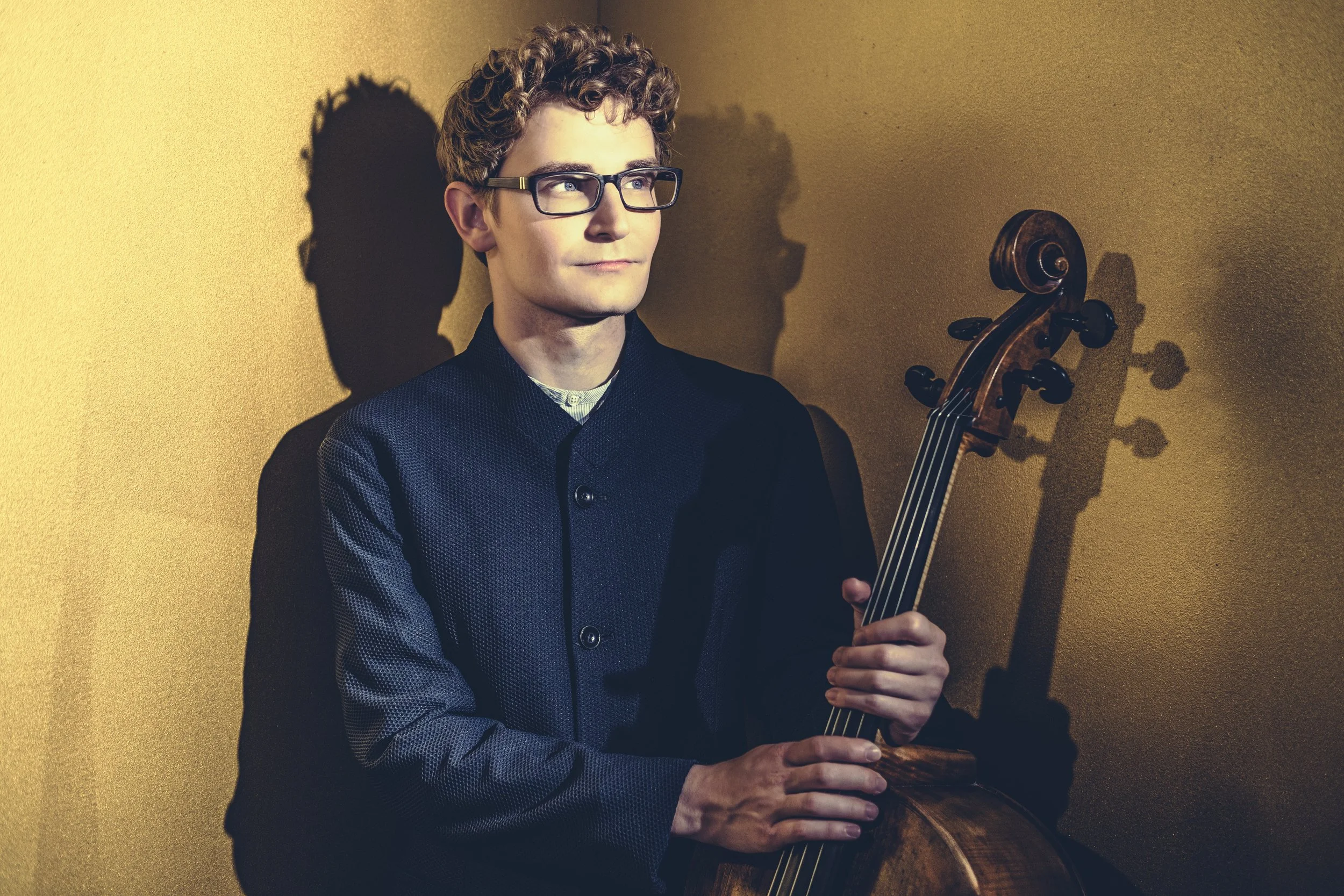
Robert Croan of the Palm Beach Arts Paper writes:
“Chamber music concerts are too infrequent in this area, cello recitals even rarer, and a program showcasing the two sonatas for cello and piano by French composer Gabriel Fauré (1845-1924) is quite extraordinary.
Just about everything in the March 7 concert of Chamber Music at Lauderdale-by-the-Sea, at the Community Church on Bougainville Drive, was in fact extraordinary. Following a conventional warm-up on a Beethoven sonata (Op. 5, No. 2), the duo of cellist Alexander Hersh and series director/pianist Victor Santiago Asunción played the two Fauré sonatas (about 20 minutes each) in succession, then turned to two shorter but cutting-edge works that exploited the cello’s (and the cellist’s) range and expressive possibilities.
No less extraordinary was the consistent high quality of the playing. Asunción is a known quantity by now, his immaculate technique and richly colorful tonal spectrum having enhanced previous events in this worthy local series. Hersh is new to South Florida, but familiar to many here from his appearances on the PBS show, Now Hear This.
Hersh is a very individual performer who says something in every line he plays. His cello sound, his phrasings, give his music making a character unlike other interpreters. Even in the innocuous early Beethoven work, his bulky resonance and incisive pulse made the time-honored music seem new. He was not loath to harshen his tone for an effect, or to re-emphasize a phrase that the piano had just stated, in a new way.
The Fauré sonatas come from a late period in the composer’s life, when he was going deaf (a sad parallel to Beethoven), and they have a more unsettled, contemporary nature than most of his output. Where the Beethoven was about dialogue and accord between the two protagonists, the French music reveled in conflict and juxtapositions. Author Marcel Proust, a close friend of Fauré, called his music from this time “truly modern.”
The two players attacked the opening Allegro theme of Fauré’s First Sonata (in D Minor, Op. 109) with elan. Hersh’s deep cello imparted the aspect of a baroque sarabande to the Andante, Asunción’s keyboard work often approximated the cello’s tenor timbre. He has an ability to play at full volume without losing tonal beauty, or in contrast, to wrap the other instrument with filigrees of sound while coming through clearly on his own. Their rendition of the finale highlighted that movement’s frequently shifting harmonies, maintaining a feeling of longing and unrest.
Sonata No. 2 was premiered in 1922, five years after the previous sonata, and its opening movement is even more dramatic and tumultuous. Its middle movement is taken from a funeral elegy that Fauré had composed the previous year to commemorate the centenary of Napoleon’s death. The performers played it with intensity and a steady beat, giving way to a happier, conversational demeanor in the sonata’s Allegro vivo conclusion.
Berlin born Lukas Foss (1922-2009) had emigrated to the United States to escape from the Nazis. He wrote his six-minute Capriccio for cellist Gregor Piatigorsky in 1948, in part to celebrate his freedom. To give the piece an “American” flavor, Foss looked to the iconic Aaron Copland, evoking in his main theme the “Hoedown” from the older composer’s Billy the Kid ballet. Foss made great demands on the performer’s special skills, and Capriccio is a tour de force for any cellist. Hersh took it in stride and the two players made it sound like fun.
For an encore, Hersh played a wildly unconventional and fiendishly difficult solo work, Lamentatio, composed in 1998 by Italian composer Giovanni Sollima (b. 1962). Hersh called it “Gregorian chant meets Metallica,” but there’s much more: jazz, rock, minimalist repetition, high harmonics, and passages in which the cellist must sing simultaneously in imitation of the string sound, creating uncanny duets with himself. It had to be seen to be believed.”